Bepress regularly hosts webinars and live events on a variety of topics related to IR management, development, and success. Presented by both bepress and Digital Commons community members, these webinars share innovative ideas and best practices for building an IR that is of clear value to the academic, professional, and regional communities it serves. To find out about upcoming webinars, please visit our Events page. You can find New Feature Webinars in the Reference Materials section.
UPCOMING:
A Tour of bepress Digital Commons: Successful IRs in Action
Tim Tamminga, bepress, VP Global Sales
Thursday, June 6, 9am Pacific / 12pm Eastern
Not Another Cross-Search Tool: The Digital Commons Network
Jean-Gabriel Bankier, CEO & President, bepress
Thursday, June 20, 11am Pacific / 2pm Eastern
-
IRs Supporting Community Engagement, Part 3: Open-Access Transportation Research at Purdue University
David Scherer, the Scholarly Repository Specialist at Purdue University, describes the rewards of the partnership between Purdue's repository, e-Pubs, and Indiana's Joint Transportation Research Program (JTRP). David and his team at e-Pubs have worked to archive and showcase the fruits of over 75 years of strong collaboration between Purdue University and what is now the Indiana Department of Transportation--research that has a significant impact on the safe and efficient operation of transportation systems throughout Indiana, the United States, and around the world. David discusses the benefits that the IR’s partnership with the program has yielded for the library, the JTRP, and the wider community, and suggests strategies for forging similar partnerships at your own institution.
-
Building a Successful Law Repository with Limited Resources
Institutional repositories (IRs) aren't just for big schools with big budgets; they are quickly developing into essential components of every law library’s information architecture in the digital age. With the right technology and a clear vision in place, institutions of any size can build a successful showcase for the full range of their research and scholarship.
At Santa Clara Law School, David Holt has strategically leveraged limited resources to build Santa Clara Law Digital Commons into a rich and diverse repository that already contains nearly 4,000 objects and has logged over 300,000 downloads from over 150 countries in the past year—all without a single full-time employee exclusively devoted to the project. In this webinar, David outlines some keys to his success:
- Defining the mission and setting goals for the repository
- Developing collections: Law reviews, special collections, faculty publications, and beyond
- Distributing workflows economically
- Encouraging faculty participation
- Promoting the IR
The presentation is of interest for law schools who are considering launching a repository as well as those who are in the mature stages of their IR initiatives.
-
IRs Supporting Community Engagement, Part 2: Regional Research at Brockport (SUNY) and UMass (Amherst)
Institutional repositories can play a key role in a college or university’s mission to serve the greater community. At the College at Brockport (SUNY), Kim Myers views the repository as an ideal venue for supporting and sharing regional, community-oriented scholarship. SUNY Brockport has long been a center for Great Lakes research, but for years this valuable research was housed primarily on one professor’s computer. Working with Professor Joseph Makarewicz, Kim has created an IR collection to archive and disseminate these research articles, government documents, community newsletters, and technical reports.
At the University of Massachusetts, Amherst, Scholarly Communication & Special Initiatives Librarian Marilyn Billings works with university administration, research centers, and departments across campus to make the IR the showcase for the university’s community-engaged scholarly work. Encompassing thousands of theses and dissertations, oral histories, outreach programs, journals, newsletters, and policy papers, the IR’s Community-Engagement collections also provide a central location for documenting the university’s eligibility for the Carnegie Elective Classification in Community Engagement. In this webinar, Kim and Marilyn will share their distinct experiences and motivations for mounting regional, community-oriented IR collections, the role of the IR collections in gaining grants and supporting continued research, and the benefits that open-access to such scholarship brings to the local community.
-
IRs Supporting Community Engagement, Part 1: Campus and Community Partnerships at Linfield College
Building partnerships with community-oriented research centers and departments is one of the best ways to develop an institutional repository into a valued community resource. In this webinar, Kathleen Spring (Collections Management Librarian) and Brenda DeVore Marshall (Professor of Theatre and Communication Arts) share how they're using the institutional repository at Linfield College to support the Linfield Center for the Northwest, the Pacific City Arts Association, and the Pacific City Dorymen's Association. By publishing oral histories, archival materials, and research generated through these centers, the repository plays a central role in a project that includes student internships, physical exhibits, and even an original theatrical production.
-
Building an Outstanding Student Research Journal in the IR
Excellence in teaching and learning is at the core of the mission statement at Illinois Wesleyan University, and the repository supports this mission in creative and innovative ways. Among the many collections of student research in Digital Commons @ IWU is the outstanding student journal, the Undergraduate Economic Review, now in its seventh year of production. In this webinar, Stephanie and Michael will talk about the intensive student work and faculty advising that goes into publishing the journal, the benefits participation has brought to students and faculty, and the repository’s role in supporting and cultivating the highest level of quality in student scholarship.
-
Introducing the Digital Commons Law Network
Representing over 50 law schools, the DC Network is one of the biggest open-access collections of law scholarship in the world and includes material from top schools like Duke, Yale, UC Berkeley, Northwestern, Cornell and Georgetown. Showcasing law review articles, book chapters, briefs, working papers, conference proceedings, and other original scholarly work, the Digital Commons law network is completely open access, meaning researchers will never run into paywalls or empty records—only full-text, open access research and scholarship are included.
-
bepress Digital Commons: The Magic Behind Search Engine Discoverability
Today's researchers regularly use the internet to find scholarly materials, making it vital that your repository content is discoverable by search engines. Join us to learn how the bepress technical team optimizes Digital Commons repositories for discovery by Google, Google Scholar, and other search engines, making it easy for researchers to find what they need. Topics include:
- User search behavior, and how to use it to connect scholars with resources
- What bepress does to bring Digital Commons content to the top of the search results in Google, Google Scholar, and other major search engines
- The unique tools Digital Commons offers to help IR administrators enter the best possible information for search engine discoverability
-
Serving Students and Faculty with Open-Access Textbooks
Many professors are developing their own textbooks for use in their courses, and institutional repositories make the perfect publishing venue for these valuable resources. In this webinar, Sarah Beaubien and Charles Lowe of Grand Valley State University share their success in bringing students targeted, high-quality texts at minimal or no cost. Charles, Associate Professor in the Department of Writing and editor of two OA texts, discusses the process of creating an OA textbook and using it in his teaching; and Sarah, Scholarly Communications Outreach Coordinator at GVSU, discusses the services the IR offers for these and other original OA texbooks by GVSU faculty.
-
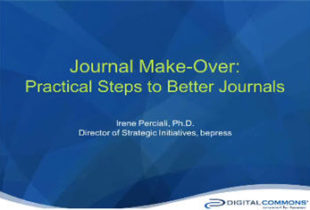
Journal Make-Over: Practical Steps to Better Journals
This webinar presents the strategies that commercial publishers use to improve the profile and impact of a journal. A few simple steps can make a significant difference for many journals. Irene emphasizes four essential steps toward better journals: recruiting more submissions, conveying credibility through the journal's homepage and design, speeding editorial workflows, and building your readership. Drawing on the nearly 500 journals on the bepress Digital Commons platform, the webinar also suggests specific benchmarks for success. The presentation is designed for library staff as well as faculty and student editors.
-
Library-Led Publishing: Books and Faculty Monographs
At the University of Nebraska-Lincoln, Paul Royster started publishing full-length faculty monographs in the repository in 2008, and has since grown the project into a full-fledged digital imprint that includes everything from open-access textbooks to field guides, art books, and historical works. In this webinar, Paul shares strategies for launching library publishing services for books and monographs, including tips on developing policies, working with authors, and providing print-on-demand.